
Certification-ready is the mission
Our goal is one standard layout of the modular system (the same panels, gauge cluster and modules anyone can configure) built and submitted as an affordable FAA Basic Aviation Training Device. We're not there yet. This page shows the requirements, where each piece stands, and what's left.
Current status: No Summit Simulators device holds an FAA Letter of Authorization today. Time in a Summit simulator can't be logged toward certificates, ratings or currency.
A BATD
A training device that meets AC 61-136B Appendix B. With an FAA Letter of Authorization, time in it can count toward the credit the LOA specifies for private pilot, instrument rating and instrument recency.
The FAA authorizes it
The FAA's General Aviation and Commercial Division issues the LOA, normally to the device's manufacturer. An LOA is valid for five years.
What a BATD isn't
IPCs and commercial or ATP credit require an Advanced ATD. A BATD doesn't replace takeoffs, landings, cross-country, night or practical tests.
How approval works. AC 61-136B issues the LOA to the device's manufacturer, and lets an operator apply for a device that is already approved. Once our Cessna 172 and 182 configurations are complete, we plan to submit them for an LOA. If you're building your own device, contact the FAA General Aviation and Commercial Division before you build to confirm how your application will be handled. Only the FAA can issue an LOA. Nothing on this page guarantees one.
Appendix B, item by item
Each BATD requirement, how we plan to address it in a Summit configuration, and where each piece stands today. Nothing here has been evaluated by the FAA.
| Requirement | Our approach | Source | Status |
|---|---|---|---|
| Physical master / battery and alternator B.3.1.4 |
Master & Avionics Panel | Summit module | Hardware available |
| Magnetos for each engine B.3.1.4 |
Master & Avionics or Starter panels | Summit module | Hardware available |
| Fuel boost pump, pitot heat, beacon / strobe / nav / taxi / landing lights B.3.1.4 |
Electrical & Lighting Switch Panel | Summit module | Hardware available |
| Avionics master B.3.1.4 |
Master & Avionics Panel | Summit module | Hardware available |
| Self-centering yoke B.3.2.1(1) |
Logitech G Flight Yoke | Partner hardware | Hardware available |
| Self-centering rudder pedals B.3.2.1(2) |
Partner rudder pedals (Logitech or Honeycomb) | Partner hardware | Hardware available |
| Throttle, idle to full; mixture and prop B.3.2.1(3)–(4) |
Throttle quadrant | Partner hardware | Hardware available |
| Wing flaps B.3.2.1(5) |
Wing Flap Selector or Flap Switch | Summit module | Hardware available |
| Pitch trim control B.3.2.1(5) |
Trim wheel (partner hardware) | Partner hardware | Hardware available |
| Gear handle (if applicable) B.3.2.1(5) |
Landing Gear Selector | Summit module | Hardware available |
| Cowl flaps (if applicable) B.3.2.1(5) |
Cowl Flap Control | Summit module | Hardware available |
| Communication and navigation radios B.3.4.1(14)–(15) |
Partner radios today; Summit Radio Panel in development | Partner hardware | Hardware available |
| Marker beacon receiver B.3.4.1(15) |
GMA 350 audio panel today; Summit module in development | Partner hardware | Hardware available |
| Clock or timer, minutes and seconds B.3.4.1(16) |
Flight Timer / OAT / Volts | Summit module | Hardware available |
| Transponder displaying current code B.3.4.1(17) |
Transponder Panel | Summit module | Final testing |
| Flap position and pitch trim indicators B.3.4.1(12)–(13) |
On-screen instrument elements | Software | In development |
| Flight and engine instruments B.3.4.1(1)–(11) |
X-Plane 12 on the panel display | Software | Hardware available |
| Control test at startup with pass / fail B.3.3.2 |
SummitBridge startup self-test | Software | In development |
| Instructor pause, reposition, failures, track recording B.3.6 |
X-Plane 12 instructor functions | Software | Hardware available |
| Local navigation database (25 NM) B.3.6.5 |
X-Plane 12 navigation data | Software | Hardware available |
Summary of AC 61-136B Appendix B. Your qualification guide must quote each criterion verbatim. Refer to the current AC.
From panel to Letter of Authorization
Pick the aircraft
A BATD represents specific aircraft, each documented with its own panel photos and performance table. Start from one of our C172 or C182 configurations, or your own.
Build to Appendix B
Use the requirement map to make sure every required control is physical and every required display is present.
Write the QAG
The Qualification and Approval Guide documents the device: description, components, verbatim criteria compliance, performance tables and the Table E-1 checklist.
Submit to the FAA
Send the request and QAG to the General Aviation and Commercial Division. Email to the AFS-800 correspondence address is the preferred method.
The DIY certification pack
- Requirement map tying every Appendix B item to a module, partner part or software function
- QAG templates: cover, trainer description, components list, design criteria compliance and Table E-1 checklist
- Performance table templates for sea level and 5,000–6,000 ft
- SummitBridge with the startup self-test
- Panel facia layouts with standard module cutouts
The pack is being finalized alongside our own C172 and C182 submissions. Join the list and we'll send it when it's ready.
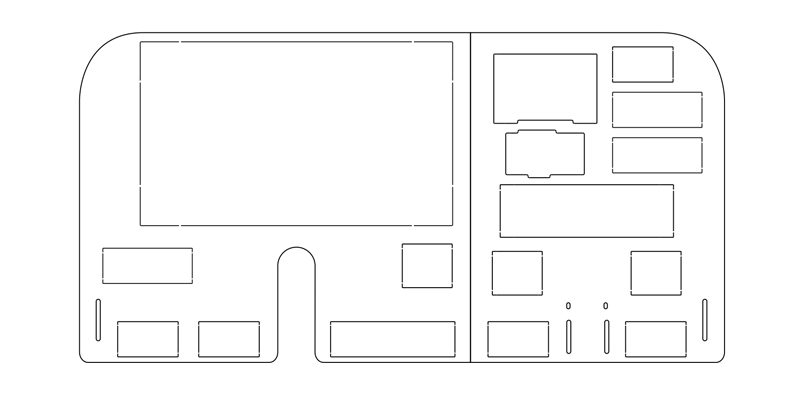
Panel facia layout with standard module cutouts.